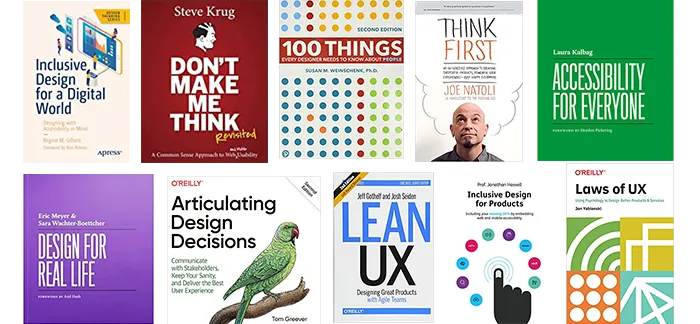
15 Essential Books for Every UX Designer
Books are a great learning resource. Over the years, the knowledge I have garnered from various design books have helped to streamline my learning process. With an abundance of available design books, picking the right one can be tough sometimes. Here is a shortlist of 15 Essential Books for Every UX Designer.

Inclusive Design for a Digital World: Designing with Accessibility in Mind (Design Thinking)
by Regine M. Gilbert
As a creator in the modern digital era, your aim should be to make products that are inclusive of all people. In Inclusive Design for a Digital World, multiple crucial aspects of technological accessibility are confronted, followed by step-by-step solutions from User Experience Design professor and author Regine Gilbert.

The Design of Everyday Things
by Don Norman
The Design of Everyday Things is a powerful primer on how — and why — some products satisfy customers while others only frustrate them. The rules are simple and include making things visible, and making intelligent use of constraints. The goal: guide the user effortlessly to the right action on the right control at the right time.

Don’t Make Me Think, Revisited: A Common Sense Approach to Web Usability
by Steve Krug
Hundreds of thousands of Web designers and developers have relied on usability guru Steve Krug’s guide to help them understand the principles of intuitive navigation and information design. Witty, commonsensical, and eminently practical, it’s one of the best-loved and most recommended books on the subject.

100 Things Every Designer Needs to Know About People
by Susan Weinschenk
This book combines real science and research with practical examples to deliver a guide every designer needs. With this book you’ll design more intuitive and engaging apps, software, websites and products that match the way people think, decide and behave.

Think First: My No-Nonsense Approach to Creating Successful Products, Memorable User Experiences + Very Happy Customers
by Joe Natoli
Designing anything for people is tough, but time and effort spent finding the right problems to solve allows designers, developers and product teams to take quantum leaps forward in exceeding the expectations of everyone involved. In Think First, you’ll find proven principles, step-by-step methods and straightforward, jargon-free advice that can be applied to any kind of digital product.

Universal Methods of Design – 125 Ways to Research Complex Problems, Develop Innovative Ideas, and Design Effective Solutions
by Bruce Hanington, Bella Martin
This expanded and revised version of the best-selling Universal Methods of Design is a comprehensive reference that provides a thorough and critical presentation of 125 research methods, synthesis/analysis techniques, and research deliverables for human-centered design.

Solving Product Design Exercises: Questions & Answers
by Artiom Dashinsky
Learn how to solve and present exercises like these, that top startups use to interview designers for product design and UI/UX roles. With this book you can practice this kind of mindset, prepare for job interview, learn how to interview other designers and find concepts for projects for your portfolio.

Design for How People Think: Using Brain Science to Build Better Products
by John Whalen PhD
User experience doesn’t happen on a screen; it happens in the mind, and the experience is multidimensional and multisensory. This practical book will help you uncover critical insights about how your customers think so you can create products or services with an exceptional experience.

Inclusive Design for Products: Including your missing 20% by embedding web and mobile accessibility
by Jonathan Hassell
In this book, the author shows you how to transform your organization to consistently and cost-efficiently create websites, mobile apps and other digital products that are usable for all of your customers.

Accessibility for Everyone
by Laura Kalbag
You make the web more inclusive for everyone, everywhere, when you design with accessibility in mind. Let Laura Kalbag guide you through the accessibility landscape: understand disability and impairment challenges; get a handle on important laws and guidelines; and learn how to plan for, evaluate, and test accessible design.

Lean UX: Designing Great Products with Agile Teams (Second Edition)
by Jeff Gothelf , Josh Seiden
Lean UX has become the preferred approach to interaction design, tailor-made for today’s agile teams. In the second edition of this award-winning book, leading advocates Jeff Gothelf and Josh Seiden expand on the valuable Lean UX principles, tactics, and techniques covered in the first edition to share how product teams can easily incorporate design, experimentation, iteration, and continuous learning from real users into their Agile process.

Articulating Design Decisions: Communicate with Stakeholders, Keep Your Sanity, and Deliver the Best User Experience
by Tom Greever, Ric Chetter
In many cases, how you communicate with stakeholders, clients, and other non-designers may be more important than the designs themselves. Because if you can’t get their support, your work will never see the light of day – no matter how good it is. This practical guide focuses on principles, tactics, and actionable methods for presenting your designs.

Laws of UX: Using Psychology to Design Better Products & Services
by Jon Yablonski
An understanding of psychology—specifically the psychology behind how users behave and interact with digital interfaces—is perhaps the single most valuable nondesign skill a designer can have. This practical guide explains how you can apply key principles in psychology to build products and experiences that are more intuitive and human-centered.

A Web for Everyone: Designing Accessible User Experiences
by Sarah Horton, Whitney Quesenbery
If you are in charge of the user experience, development, or strategy for a web site, A Web for Everyone will help you make your site accessible without sacrificing design or innovation. Rooted in universal design principles, this book provides solutions: practical advice and examples of how to create sites that everyone can use.

Design for Real Life
by Sara Wachter-Boettcher, Eric Meyer
You can’t always predict who will use your products, or what emotional state they’ll be in when they do. But by identifying stress cases and designing with compassion, you’ll create experiences that support more of your users, more of the time. You can’t know every user, but you can develop inclusive practices that support a wider range of people. This book will show you how.